
Will AI Kill Human -Centered Innovation?
From Post-its to Proof

I’ve been fairly provocative about design thinking in the past. In a previous blog titled “RIP Design Thinking,” I argued that sticky-note empathy circles and post-it-driven workshops had become a kind of innovation theatre—a ritual divorced from the hard realities of viability and impact.
Out of that critique, I introduced Designomics: the idea that economic feasibility and value creation must sit alongside desirability and feasibility in any serious design process. Innovation that doesn’t move the economic needle is not innovation; it’s a hobby.
Now AI has entered the room, and a new question emerges: Will AI make human-centered design thinking redundant—or will it finally help it live up to its promise?
My view: AI will make the old performative version of design thinking obsolete, but it will supercharge a more rigorous, human-centered, Designomics-driven version of it.
The Original Promise—and Failure—of Human-Centered Design
At its best, human-centered design (HCD) is a powerful mindset:
Start with people’s lived experiences, not technologies or org charts.
Understand context, culture, constraints, and aspirations.
Co-create solutions with those affected, not for them.
In practice, however, much of what passes for “design thinking” today suffers from three chronic diseases:
Shallow empathy
A few interviews, a journey map, some personas—and we declare victory. But we seldom get a longitudinal, multi-dimensional view of people’s lives.Idea fetishism
We fall in love with “how might we” statements and brainstorming sessions, yet we rarely follow through with robust experimentation, iteration, and scaling.Economic amnesia
We design something desirable and sometimes even feasible—but we don’t model whether it is sustainable, scalable, or truly value-accretive. That’s where Designomics comes in.
The result: beautiful decks, limited impact.
Enter AI: Threat or Catalyst?
AI intensifies the anxiety: If large language models can generate 100 ideas in a minute, run simulations, and propose interfaces, do we still need human-centered design?
I think we’re asking the wrong question. The real question is: Are we willing to let AI automate our laziness—or will we use it to amplify our seriousness about humans and outcomes?
AI will absolutely automate parts of the process of design thinking:
Synthesizing qualitative data
Generating “how might we” questions
Exploring solution permutations
Producing quick visual prototypes
But that doesn’t mean it replaces human-centeredness. If anything, it exposes how un-human and un-rigorous a lot of current design practice actually is.
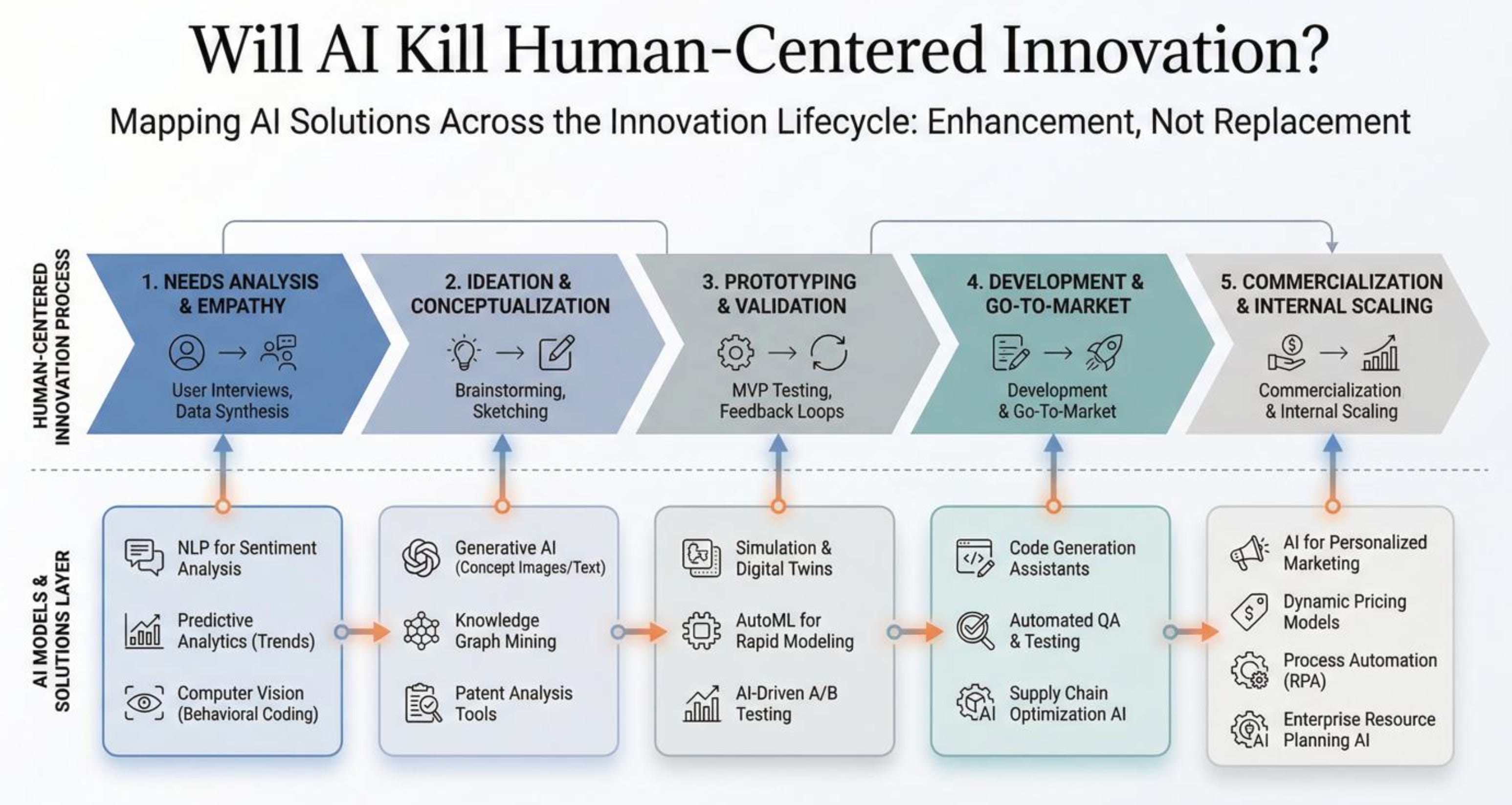
AI + Human-Centered Design: A New Stack
Let’s look at how AI can augment each phase of a serious human-centered, Designomics-aware design process.
1. Empathy: From Focus Groups to Lived-Data
Old way:
A handful of interviews, a workshop, a few quotes on a slide.
AI-augmented way:
Analyze millions of data points from call center logs, patient portals, social media, wearables, and service usage.
Use AI to detect hidden patterns: frustration hotspots, dropout points, emotional tone over time.
Cluster users not just by demographics, but by behavior, intent, and risk.
This doesn’t replace human empathy—it scales it.
We move from “we spoke to 12 users” to “we’re seeing the lived behavior of 120,000 users over 12 months.”
For a healthcare service, for example, AI can reveal:
Where patients abandon a digital pathway
Which phrases in clinician notes correlate with poor adherence
How socioeconomic factors and digital literacy shape outcomes
Now when we sit down with real people, we’re not guessing—we’re ground-truthing rich, AI-derived insights.
2. Ideation: From Whiteboard Brainstorms to Generative Exploration
Old way:
Get the “creatives” in a room, throw out ideas, vote with stickers.
AI-augmented way:
Use generative models to propose hundreds of solution directions that combine patterns from healthcare, retail, fintech, and beyond.
Stress-test ideas instantly: What happens if connectivity is low? If regulation changes? If cost thresholds shift?
Ask AI to design from different perspectives: the user, the frontline worker, the CFO, the regulator.
Humans still decide what matters, but AI expands the option space and makes our creativity less parochial and less constrained by our individual cognitive biases.
3. Prototyping & Testing: From Pilots to Simulations
Old way:
Build a basic prototype, test with a small group, maybe run a short pilot.
AI-augmented way:
Use AI to build high-fidelity prototypes (interfaces, workflows, scripts, chatbots) in hours instead of weeks.
Run synthetic simulations: agent-based models, digital twins of patients, environments, or systems, to predict how solutions behave at scale.
Identify failure modes before they hit the real world.
This is particularly powerful when combined with real-world data:
You can simulate how a new appointment system affects wait times, staff load, and no-show rates across different clinics and demographics.
You can model how a new digital tool will perform in low-connectivity vs high-connectivity environments.
Prototyping stops being a one-off pilot and becomes a continuous learning system.
4. Designomics: Embedding Economics into the Loop, Not the End
This is where AI and Designomics really meet.
Old way:
Design first, then ask reluctantly: “Can we afford this?” or “Will this scale?”
AI-augmented Designomics:
Run real-time ROI projections: revenue, cost savings, productivity gains, reduced churn, improved health outcomes.
Explore multiple business models: subscription vs transaction, employer-paid vs out-of-pocket, value-based vs fee-for-service.
Incorporate constraints and trade-offs explicitly: If you optimize for equity, what is the short-term margin impact? If you optimize for speed, what happens to safety?
AI makes it possible to treat economics as a first-class design material, not an afterthought.
In other words, you can practice Designomics at scale.
5. Implementation & Iteration: From Launch Events to Living Systems
Too often, design thinking ends with a launch, a press release, or a case study.
AI lets us turn implementations into learning organisms:
Monitor usage in real time.
Detect friction points and drop-offs dynamically.
Automatically generate design improvement suggestions based on actual behavior.
Continuously re-optimize for both human experience and economic performance.
This is no longer “project-based design”—it’s ongoing, AI-driven design operations, where human-centeredness and Designomics are constantly recalibrated in the wild.
What Remains Un-Automatable (For Now)
With all this AI capability, what remains uniquely human?
Choosing the right problem
AI can help you reframe and explore, but it doesn’t decide which problems are ethically, socially, or strategically meaningful to tackle.Moral judgment
Just because a solution is efficient and profitable doesn’t mean it’s just, humane, or desirable for society. That judgment is still ours.Contextual wisdom and lived experience
AI can ingest patterns, but it doesn’t live in a body, in a neighborhood, in a culture. It doesn’t experience fear, dignity, stigma, or hope.Accountability
When a solution harms people—no matter how “AI-designed” it was—humans will and should be held responsible.
In other words:
AI can augment the design process, but humans must still anchor it.
From Design Thinking to “AI-Native Designomics”
So where does this leave us?
I don’t believe in “RIP design thinking” in the sense of abandoning human-centered design.
I do believe in saying RIP to:
Design as theatre
Empathy as a workshop exercise
Innovation with no business model
Prototypes with no path to scale
In their place, I see an emerging paradigm I’d call AI-Native Designomics:
A human-centered, AI-augmented design practice where desirability, feasibility, and viability are continuously optimized in real time.
Core principles:
Human-centered by default, data-enriched by design
Start with real people and their lived realities, then use AI to deepen and scale your understanding—not to replace it.Economics as a design constraint, not a veto
Use AI to explore sustainable, equitable business models from day one, not as a late-stage CFO hurdle.Continuous, AI-driven learning loops
Treat every release as a live experiment. Measure, adapt, and redesign based on behavioral and economic signals.Ethical guardrails and governance
Build explicit norms and oversight around how AI is used in the design process: what data is used, whose voice gets amplified, who gets left behind.
So, Will AI Kill Human-Centered Design Thinking?
Here’s my answer:
Yes, AI will make shallow, workshop-driven design thinking obsolete.
The version that was more about post-its than patients, more about theatre than outcomes—that should disappear.No, AI will not kill human-centered design.
Properly harnessed, it will make it more human, more evidence-driven, and more economically honest than ever before.
The real risk is not that AI replaces design thinking.
The real risk is that we use AI to scale bad design faster—solutions that are not truly human-centered, not economically sustainable, and not ethically governed.
The opportunity, however, is profound:
To build an era of AI-native Designomics, where we design not just what people want and can use,
but also what the world can sustain, systems can fund, and societies can trust.
That’s the future of human-centered design I’m interested in—and AI, far from being the undertaker, might be its most powerful co-designer.
Rubin Pillay MD,PhD is a world leader in AI enabled healthcare innovation. https://futuremedacademy.com/